.svg)



Consultation
Dr. Osayande evaluates brow position, forehead and hairline anatomy, eyelid skin, facial symmetry, medical history, and your goals. Photographs help document the relationship between the brow and upper eyelids.

The Signature Regenerative Boost is an add-on to microneedling of the face, neck, chest, or scalp, applying PRP drawn from your own blood or a PDGF growth factor preparation to support skin renewal. Signature Facial Plastic Surgery serves patients in Rockville, Bethesda, and the greater Washington, DC area.
Growth factors, applied at the right moment
Microneedling briefly opens channels in the skin as part of how it works. The Signature Regenerative Boost takes advantage of that window by applying growth factors directly to freshly treated skin — either PRP prepared from your own blood, or a PDGF preparation.
The boost can be added to microneedling anywhere it is performed: the face, neck, chest, or scalp. The aim is to support your skin's own healing and renewal response while it is most receptive, rather than to replace the microneedling itself.
The Regenerative Boost is an add-on to microneedling rather than a standalone treatment, and it follows the same timeline as the microneedling it accompanies. Evidence for regenerative treatments continues to develop, and individual response varies more than it does with more established options.
Thoughtful patient selection

You may be a good candidate if you are already planning microneedling — whether for the face, neck, chest, or scalp — are in good general health, and want additional support for skin renewal within the same appointment.
PRP requires a blood draw and is less suitable for patients with certain blood or clotting conditions, or those taking particular medications. Where PRP is not appropriate, PDGF may be an option. This is reviewed at consultation.
Chosen for you, not offered by default
Whether PRP or PDGF suits you depends on your health history, your comfort with a blood draw, and the area being treated. Dr. Osayande will tell you plainly when the boost is likely to add meaningful value and when it is not worth the additional cost.
When PRP is used, blood is drawn at the start of your visit and processed while the treatment area is numbing, so the appointment runs without an extra step.
“Microneedling opens a window in the skin. The boost is about what you put in it while it's open.”
From consultation through your series
Dr. Osayande evaluates brow position, forehead and hairline anatomy, eyelid skin, facial symmetry, medical history, and your goals. Photographs help document the relationship between the brow and upper eyelids.
Your incision pattern, degree of repositioning, anesthesia plan, and whether another procedure would add meaningful benefit are selected for your anatomy—not from a standard formula.
Brow lift surgery is performed with anesthesia appropriate to the planned technique and setting. The tissues are carefully repositioned and secured while the incisions are closed with attention to scar quality.
Scheduled postoperative visits allow Dr. Osayande to monitor swelling, incision healing, brow position, and your gradual return to normal activities.
Planning your downtime
Healing varies by patient, but the following timeline offers a general framework.
Redness and warmth, as with microneedling alone. Prescribed products only, and no makeup.
Redness settles as the skin calms.
Early improvement in texture and tone becomes visible.
Results build with each session and are assessed together with your microneedling plan.
On the same timeline as microneedling: early change at four to six weeks, building over several months.
Improvement follows the same course as microneedling and is supported by sun protection and maintenance. Individual response to regenerative treatments varies more than it does with more established options.
The risks of microneedling, plus bruising or tenderness at the blood draw site when PRP is used.
Considering upper-face rejuvenation?
Your consultation will determine whether the change you see comes primarily from the brow, upper eyelids, dynamic muscle activity, or a combination of factors.
Why choose Signature
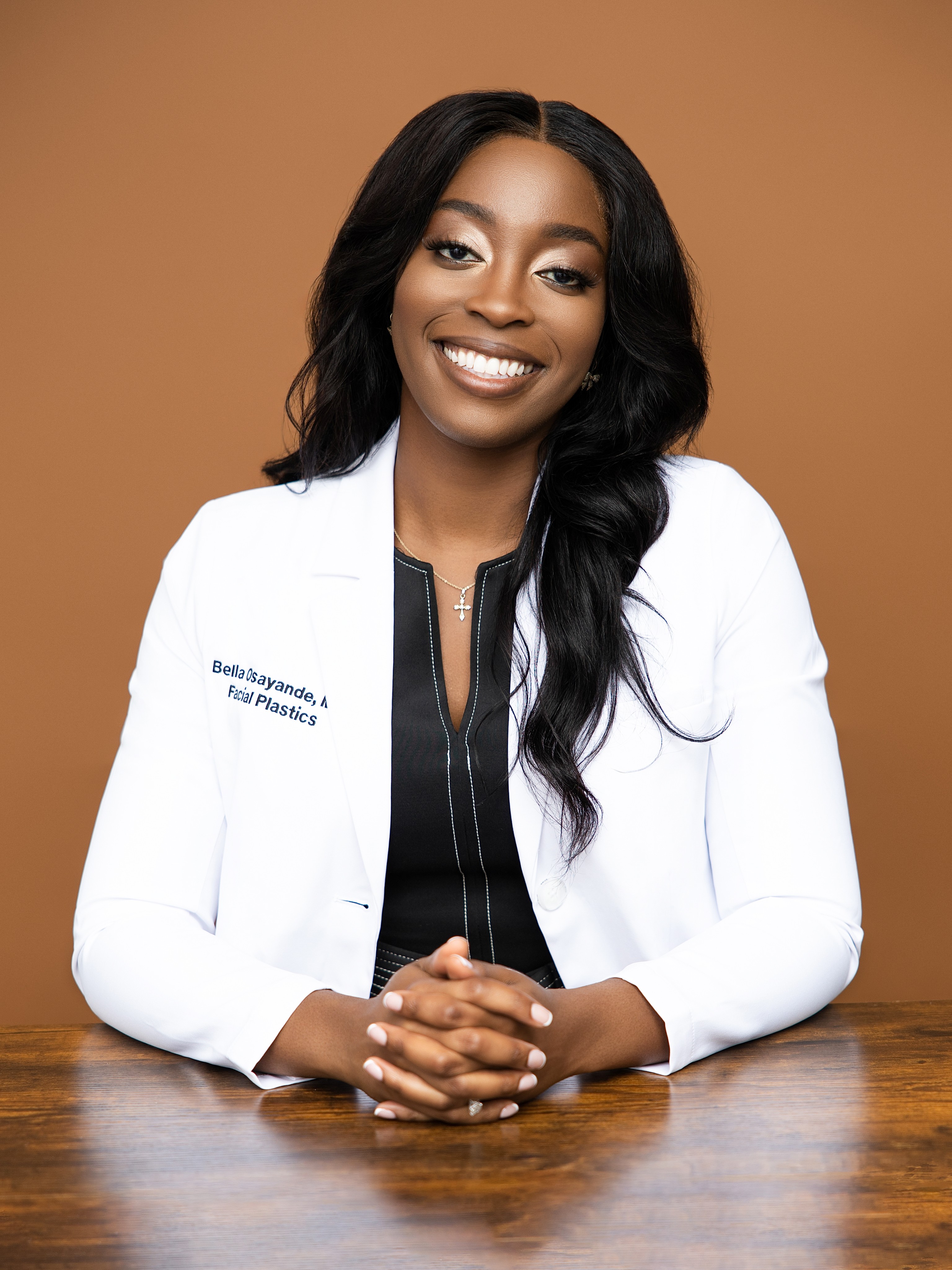
Dr. Bella Osayande is a fellowship-trained facial plastic surgeon whose practice is focused on the face, eyes, brows, nose, neck, and hair. That focused training supports a comprehensive, whole-face approach to every procedure she performs.
Her approach emphasizes precise planning, natural facial expression, honest treatment recommendations, and results that feel proportionate to the individual—not a predetermined aesthetic ideal.
Frequently asked questions
Clear answers to common questions about surgery, recovery, scars, and treatment selection.
An add-on to microneedling that applies either PRP drawn from your own blood, or a PDGF growth factor preparation, to freshly treated skin. It can be added to microneedling of the face, neck, chest, or scalp.
PRP is prepared from a small sample of your own blood during the visit. PDGF is a growth factor preparation that requires no blood draw. Which one suits you is discussed at consultation.
Yes. A small sample is taken at the start of your appointment and processed while your skin is numbing.
No meaningful downtime beyond microneedling itself, though recovery varies by treatment area and individual response.
In most cases, yes — face, neck, chest, or scalp. It can be added to a single session or built into a planned series.
Yes. Scalp microneedling with growth factors is offered as part of the practice's hair restoration care and is planned alongside your hair goals. Regenerative scalp microneedling has its own page with more detail.
