.svg)



Consultation
Dr. Osayande evaluates brow position, forehead and hairline anatomy, eyelid skin, facial symmetry, medical history, and your goals. Photographs help document the relationship between the brow and upper eyelids.

FUE, or follicular unit excision, is a hair restoration technique that harvests individual follicular units from the donor scalp and transplants them to thinning areas without leaving a linear scar. Signature Facial Plastic Surgery serves patients in Rockville, Bethesda, and the greater Washington, DC area.
A hairline built for your face
Follicular unit excision removes individual follicular units from a donor area at the back and sides of the scalp, where hair is genetically resistant to pattern loss, and places them where density has been lost. Because units are taken one at a time, there is no linear donor scar.
The work that determines whether a result looks natural happens before any graft is placed: where the hairline sits, how it is shaped, and the angle each follicle takes as it leaves the scalp.
A transplant redistributes the hair you already have; it does not create new follicles. Donor supply is finite, which is why planning has to account not just for how you look now, but for how your hair loss may progress over the coming decades.
Thoughtful patient selection

You may be a good candidate if you have adequate donor density, a pattern of loss that has stabilized or is being managed medically, realistic expectations about achievable coverage, and you are in good general health.
Patients whose loss is still progressing rapidly, or who have limited donor supply relative to the area they want covered, may be advised to start with medical therapy, to stage the work, or to reconsider the goal. That conversation happens honestly at consultation.
Design first, then technique
Dr. Osayande designs the hairline around your facial proportions rather than a standard template, accounting for how the frame will age. A hairline placed too low or too straight is the most common reason a transplant reads as obvious.
Graft placement follows the native direction and angle of surrounding hair, and single-hair grafts are used along the leading edge to keep it soft rather than abrupt.
“A hairline has to suit the face it frames, and the face it will frame in twenty years.”
From consultation through regrowth
Dr. Osayande evaluates brow position, forehead and hairline anatomy, eyelid skin, facial symmetry, medical history, and your goals. Photographs help document the relationship between the brow and upper eyelids.
Your incision pattern, degree of repositioning, anesthesia plan, and whether another procedure would add meaningful benefit are selected for your anatomy—not from a standard formula.
Brow lift surgery is performed with anesthesia appropriate to the planned technique and setting. The tissues are carefully repositioned and secured while the incisions are closed with attention to scar quality.
Scheduled postoperative visits allow Dr. Osayande to monitor swelling, incision healing, brow position, and your gradual return to normal activities.
Planning your downtime
Healing varies by patient, but the following timeline offers a general framework.
Sleep with your head elevated. The recipient area is left undisturbed, and washing follows the specific instructions you are given.
Crusting around the grafts resolves with gentle washing, and donor area discomfort settles.
Transplanted hairs shed. This is an expected part of the cycle and does not mean the grafts have failed.
New growth begins around months three to four and thickens progressively, with the fuller result at twelve to eighteen months.
Growth begins around months three to four, with the fuller result visible at twelve to eighteen months.
Transplanted follicles are generally durable. Untransplanted hair can continue to thin, so a long-term plan often includes medical therapy.
Bleeding, infection, temporary numbness, folliculitis, poor graft survival, and visible marks in the donor area.
Considering upper-face rejuvenation?
Your consultation will determine whether the change you see comes primarily from the brow, upper eyelids, dynamic muscle activity, or a combination of factors.
Why choose Signature
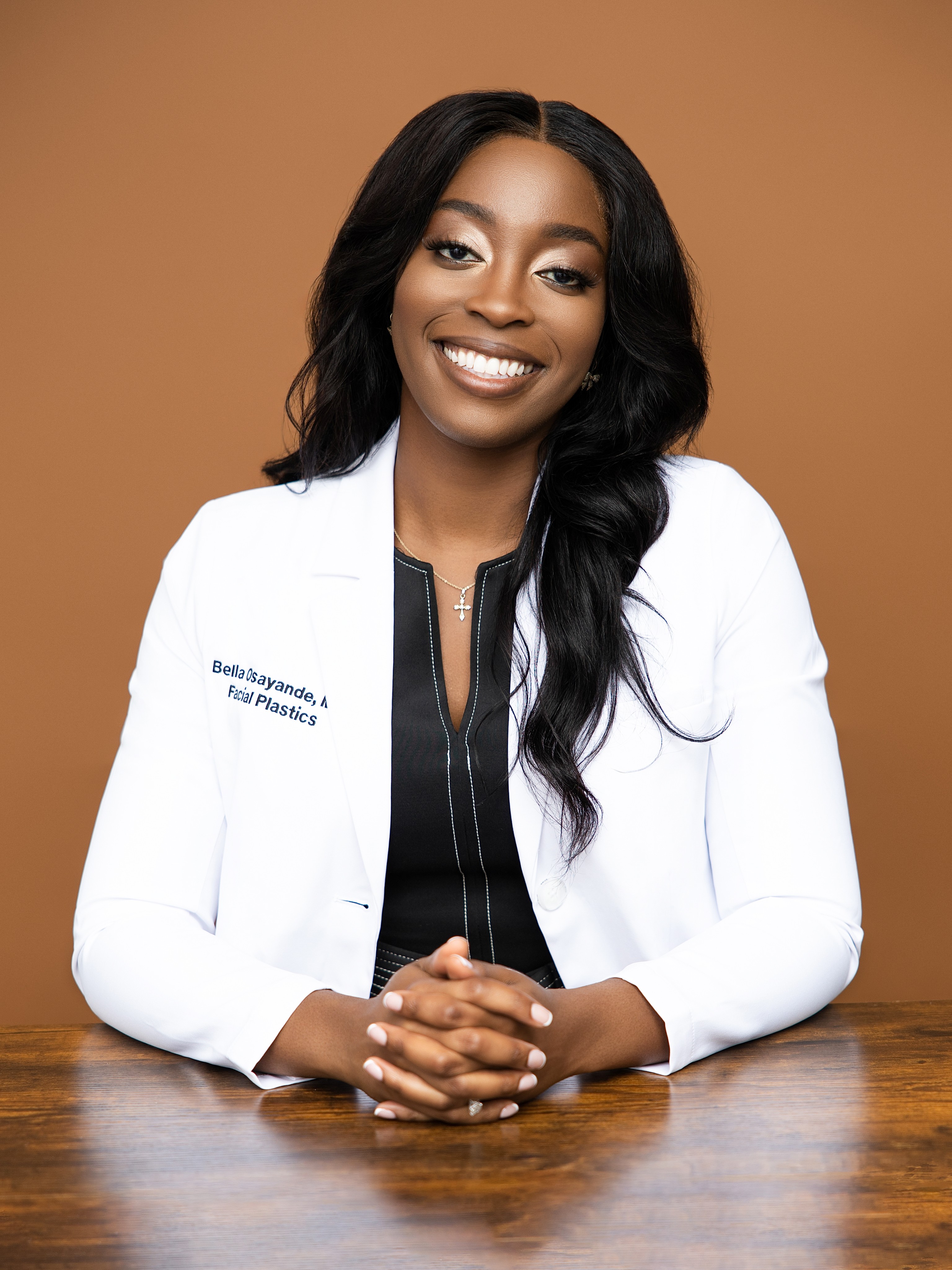
Dr. Bella Osayande is a fellowship-trained facial plastic surgeon whose practice is focused on the face, eyes, brows, nose, neck, and hair. That focused training supports a comprehensive, whole-face approach to every procedure she performs.
Her approach emphasizes precise planning, natural facial expression, honest treatment recommendations, and results that feel proportionate to the individual—not a predetermined aesthetic ideal.
Frequently asked questions
Clear answers to common questions about surgery, recovery, scars, and treatment selection.
Most sessions run six to eight hours depending on graft count, and are performed in a single day under local anesthesia with oral sedation available.
FUE leaves small circular marks in the donor area rather than a linear scar. These typically become difficult to see once the hair grows out, which is why FUE suits patients who wear their hair short.
Transplanted hairs shed within the first few weeks, which is expected. New growth generally begins around months three to four, with the fuller result visible at twelve to eighteen months.
Graft count is planned, not quoted from a chart. It depends on how much area needs coverage, how dense your donor supply is, the caliber and curl of your hair, and how likely your hair loss is to progress. Two patients with a similar hairline can need very different numbers.
Dr. Osayande estimates your graft count at consultation, after examining your donor area, and explains the reasoning behind that number before anything is scheduled.
The donor area is usually shaved for graft harvesting. Depending on the case, a partial shave may be possible, and this is discussed at consultation.
Follicles taken from the donor area are generally resistant to the hormone that causes pattern hair loss, so transplanted hair tends to persist. Your untransplanted hair can continue to thin, which is why a long-term plan often includes medical therapy.
